
How Laguna Niguel Residents Are Found
Start with the fact you want, not the widest search you can run. Ownership questions lead to the Laguna Niguel Public GIS Viewer, the Orange County Assessor, and the Clerk-Recorder's Grantor-Grantee Index. A court event belongs in the superior court's search. A birth, death, or marriage question belongs with the county clerk or the California Department of Public Health. Older family research leans on newspapers, census schedules, city directory volumes, and archives. The strongest Laguna Niguel residents directory work is a chain of small resident lookup steps, each one narrow.
Remember that no two sources describe the same population. A deed names the parties to one instrument. A parcel map locates land. A court index notes a case event. A voter rolls entry confirms one person's own registration. None of that proves who lives at a parcel today. Keep names, dates, roles, and identifiers in separate notes so a promising lead never hardens into a conclusion the record cannot support.
- Write down the goal, such as a parcel owner, a past household, an heir, or a public affiliation.
- Fix the geography with a street address, APN, tract, lot, or ZIP before comparing names.
- Use the custodian with the closest record type, then save the date, case number, instrument number, or license number.
- Confirm the lead with an independent source, such as a deed against an APN or a court case against a filing date.
- Use a focused city or county request when the online index ends, rather than asking staff to build a people list.
For street-by-street work, the city map is the first bridge worth crossing. For one person, identity checks beat a long list of hits every time.
Where Laguna Niguel Keeps Resident Records
Laguna Niguel incorporated in 1989, so its records split by era and by custodian. City Hall holds the municipal layer: minutes, permits, and planning files. It also keeps contracts and code or administrative records. Orange County keeps the durable trail of property rolls, vital certificates, and court cases. It also holds elections and recorded documents. State agencies run the statewide programs, including voter status and professional licenses. They also handle business entities and confidentiality services. The office cards below mark the practical starting points for a records office visit.
Orange County Clerk-Recorder
601 N. Ross Street
Santa Ana, CA 92701
714-834-2500
Orange County Assessor
500 S. Main Street
Orange, CA 92868
714-834-2727
Orange County Registrar
1300 S. Grand Avenue, Building C
Santa Ana, CA 92705
Approved-file route
The Laguna Niguel City Clerk is another key custodian for local records. A request can go by email to cityclerk@cityoflagunaniguel.org, in person at City Hall, 30111 Crown Valley Parkway, by fax at 949-362-4340, or by mail. The clerk's phone line is 949-362-4301, and City Hall opens Monday through Friday, 8 a.m. to 5 p.m. Copies are listed at $0.10 per page. That city request suits a permit, contract, meeting record, or planning file. It cannot replace an Orange County deed or court search.
Laguna Niguel Records Across Three Levels
City, county, and state layers each answer a different slice of a resident question. City records show how a planned community was administered. They note when a permit or council action happened. They also show which local program touched an address. County systems link parcels to recorded parties, cases, certificates, and election administration. State portals add entity, license, custody, privacy, and archival routes. Mixing those levels is the most common reason a records office search looks empty.
| Level | Useful source | Evidence | Boundary |
|---|---|---|---|
| City | City Clerk, Permit Center, Public GIS Viewer | Municipal action, parcel context, permits | Pre-1989 plans may not be held by the city |
| County | Clerk-Recorder, Assessor, Superior Court | Deeds, values, cases, vital copies | Each office has its own access rules |
| State | Secretary of State, CDPH, DCA, Safe at Home | Entities, certificates, licenses, protections | Many results are not residence proof |
| Federal | NARA census, PACER, federal custody tools | Historical households or federal cases | Coverage follows federal rules and dates |
The historical boundary matters here more than most. Rancho Niguel and county-era records predate the modern city label. Searching only under Laguna Niguel can miss an earlier entry filed under Orange County, a tract, a lot, or a predecessor geography.
How the Laguna Niguel Deed Index Works
The Orange County Grantor-Grantee Index is free to search. It is an index, though, rather than a free image library. Online coverage starts January 4, 1982. Anything earlier sits on microfiche at the Santa Ana records office. A pre-1982 reference normally runs on book, page, and instrument information. From 1982 forward, an instrument is cited by recording year plus a six-digit number. Find the identifier first. Then order a copy or inspect the deed through the custodian.
| Search control | What to enter |
|---|---|
| Name role | All, Grantor, Grantee, or both roles |
| Name | LAST FIRST; partial names are accepted, and a partial first name can reduce timeouts |
| Date range | Recording date from and to in MM/DD/YYYY format |
| Document number | Annual recording number when known |
| Book and page | Useful for pre-1982 instruments and recorded maps |
| APN or legal description | Parcel or lot/tract search that helps separate same-name parties |
Search results can display 10, 20, 50, or 100 items at a time. A detail view may show party, role, document type, and date. It can also list document number, book and page, APN, or legal description. A name link can surface connected documents from 1982 forward. Copies are listed at $1 per page. A $1 certification applies per document or map. Mail orders need a self-addressed stamped envelope and a check. The recorder's staff will not run your name search by phone, mail, or counter.
- Grantor
- The party transferring an interest or signing the recorded instrument.
- Grantee
- The party receiving an interest or named as the recipient in the instrument.
- Index
- A catalog entry that points to a record; it is not the same as the document image.
- Parcel
- A defined piece of land identified by an APN and related legal description.
The Laguna Niguel APN Screen
The Assessor's value screen does one narrow job. It accepts an APN in masked 999-999-99 form. In return it lists land, buildings and improvements, other improvements, personal property, total assessed value, the exemption, net value, and the data-current date. No owner name appears. Nor does an owner mailing address. A situs address, an occupant, a deed image, or a complete sale history is also missing.
That gap makes the city map a good companion. The Laguna Niguel Public GIS Viewer accepts an address or an APN. It exposes the parcel number, zoning, General Plan designation, HOA, tract, lot, coordinates, and electric provider. The GIS answer gives geography and planning context. The Assessor answer gives assessed value. The recorder answer is an indexed trail of transactions. Each system answers a different question about the same parcel.
The county property-information page points to two routes. Those are ParcelQuest and the Public Service Counter. Roll products may require a counter visit or a focused written request. Fees apply to parcel maps, index maps, roll pages, copies, and certification. The free APN value result is not a by-name Laguna Niguel residents directory.
The Orange County Assessor property gateway opens the county system. The value query there displays exactly which fields are public in that screen. The gateway view is a search route, not a residents list. Keeping the two apart saves a searcher from expecting a property tool to behave like a Laguna Niguel street directory.
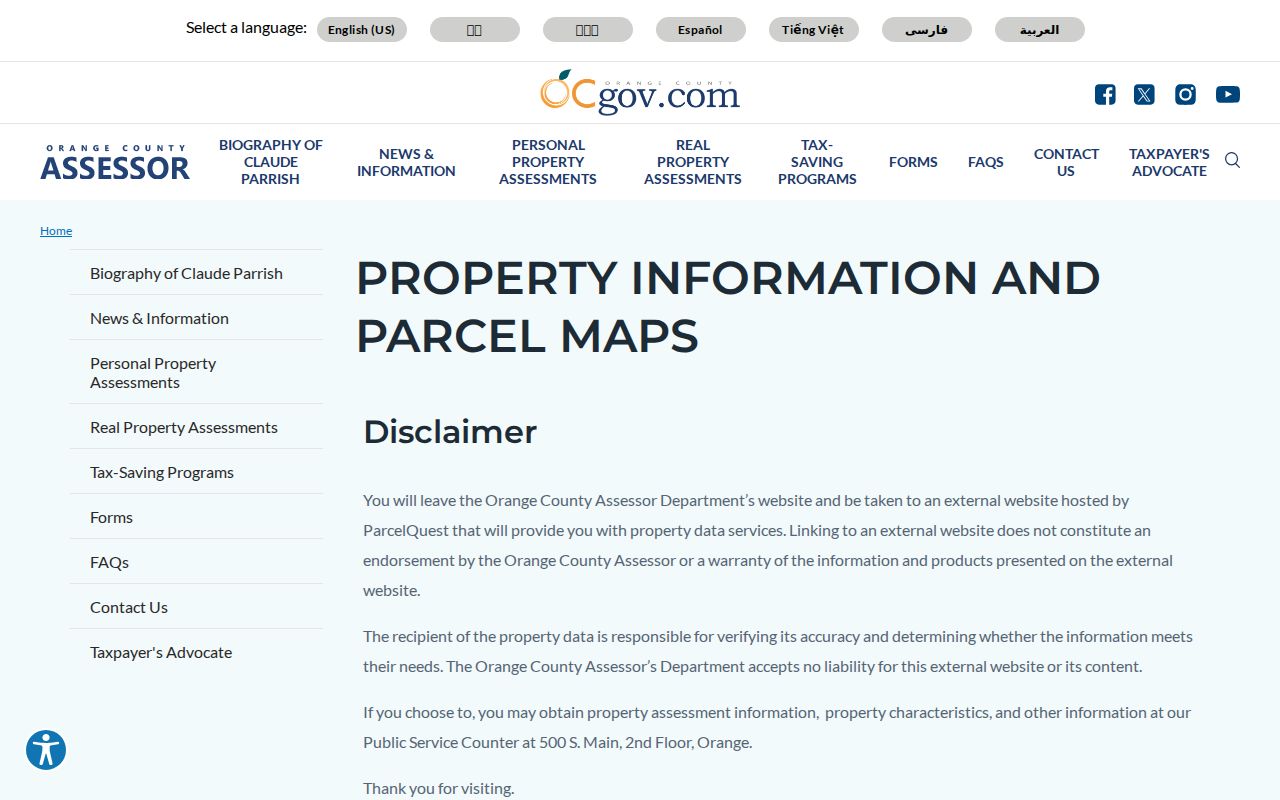
The screen works best when paired with other identifiers. Bring the APN from the city map and the instrument number from the recorder index, and the value result fits into a fuller property record.
Current Laguna Niguel Resident Sources
Current records behave as partial directories, never one book. The city staff directory lists public employees, not the general population, and the recorder index names parties to recorded instruments. Business and license portals show affiliation or regulated status, a voter file opens its residence fields only through an approved statutory route, and My Voter Status remains a self-lookup. Each source answers its own question.
| Source | What it can show | Keeper | Access |
|---|---|---|---|
| Public GIS Viewer | Parcel, tract, lot, HOA, zoning | City of Laguna Niguel | Free address/APN map |
| Assessed-value query | APN values and exemptions | Orange County Assessor | Free APN query |
| Grantor-Grantee Index | Deed and lien parties | Clerk-Recorder | Free index, paid copies |
| My Voter Status | One voter's registration details | California Secretary of State | Identity-gated self-lookup |
| Business and license portals | Entity, license, status, filed address | California agencies | Free public searches vary |
No single result deserves the name of a complete Laguna Niguel residents directory. Each record is one step in a resident trail. Every step carries its own custodian and date.
Orange County Court Matches Need Anchors
Court searching starts with the right category. The Orange County Superior Court Case Access hub splits civil, criminal and traffic, family, probate, and small claims into separate routes. The Case Name Search needs an account and purchased credits for ordinary searches. Exact and Similar matching are offered. Alias searching is not. A result normally supplies a party or business name, a case number, and a filing date, plus a register of actions or category detail when remote access permits.
Two identifiers anchor a court match. Those are the case number and the filing date. A calendar result is not a certified record. A party match does not prove a current address or settle how a dispute ended, and coverage differs across civil, family, probate, and criminal records. Family summaries generally reach cases opened in 1990 or later, while courthouse terminals and clerk procedures may expose more public material.
The Orange County case-access hub displays the category split plainly. Federal cases belong in PACER, not the county search. Older or restricted records may need a clerk request, a counter terminal, identification, or a court order.
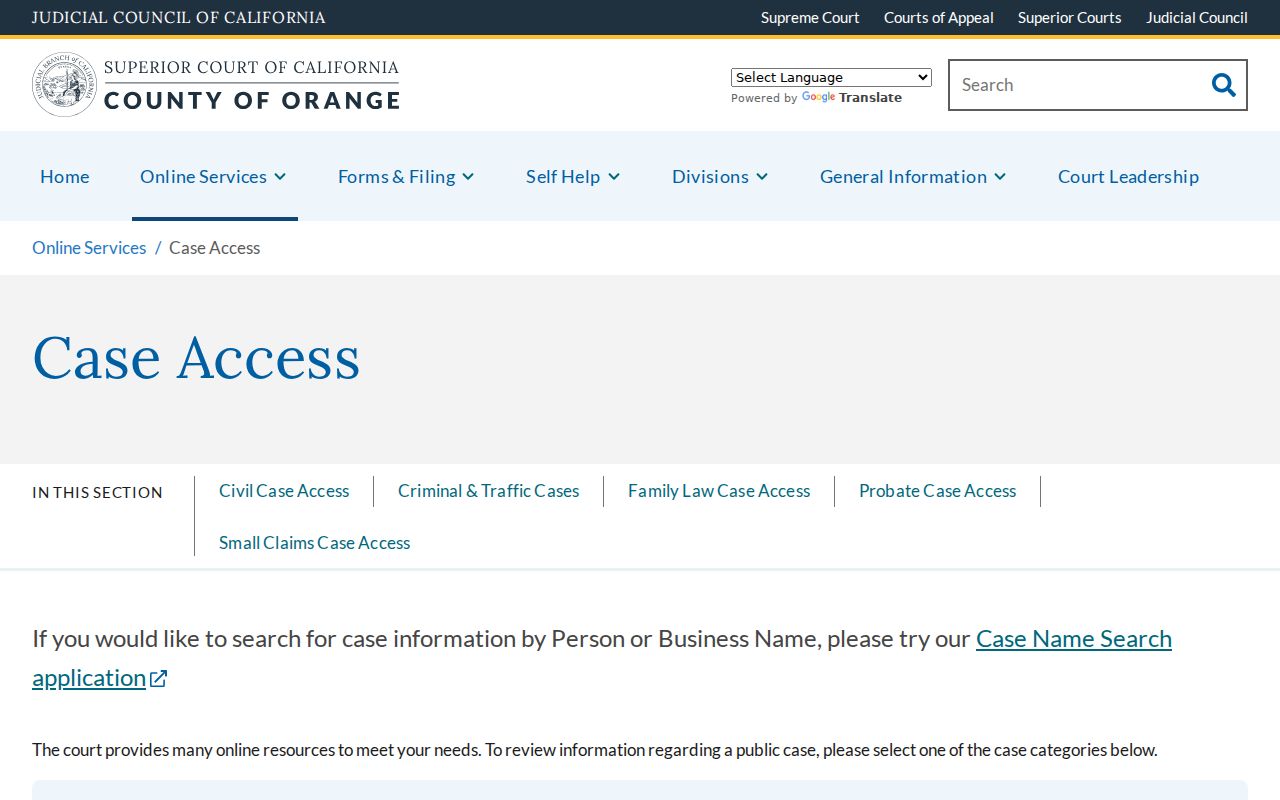
Court access is a map of routes, not a promise of full online case files.
California Voter Records Have a Gate
California voter information is no open name-and-street directory. The Secretary of State's My Voter Status service asks for a date of birth, the last four digits of a California license or identification number or an alternative identifier, and the first three characters of a first name. It exists so a voter can confirm their own registration. That design is deliberate. The Orange County Registrar releases a controlled file only for an approved election, scholarly, journalistic, political, or governmental purpose. The gate stays closed to casual browsing.
| Authorized field | Meaning or restriction |
|---|---|
| Residence and mailing address | May differ; protected voters are omitted |
| Registration and precinct | Election geography and status |
| Party preference | Registration preference, not a ballot choice |
| Participation history | Election and voting method history, never selections |
| License, SSN, signature | Confidential identifiers, not routine released fields |
The law draws hard lines here. Election Code §2194 bars personal, commercial, advertising, solicitation, marketing, and harassment uses. An Orange County application requires a stated purpose. It also requires a wet signature, supporting documents, payment, and a government photo ID copy for a mail request. Protected voters under Elections Code §§2166 through 2166.9 stay outside the file. A self-lookup is not an approved data request. The two must never be described as the same service. The California voter-status lookup fits that personal use.
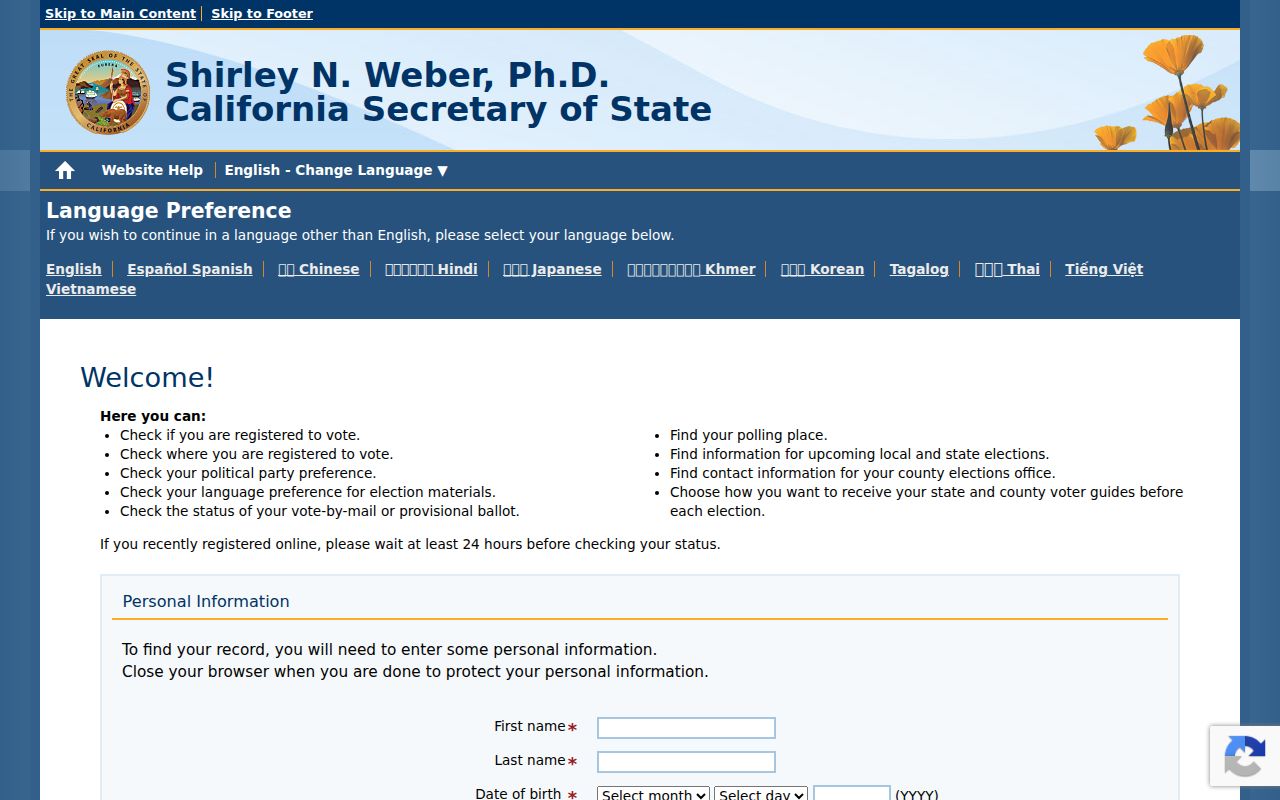
The identity gate is the point. The form does not turn Laguna Niguel streets into a public voter roll.
Laguna Niguel Vital Copy Choices
Birth, death, and marriage records are event records, not a current residents directory. The Orange County Clerk-Recorder handles county copies. CDPH Vital Records keeps statewide files and amendments, while divorce decrees come from the Orange County Superior Court. A CDPH dissolution certificate differs from the court file.
| Record | Custodian | Copy route | 2026 fee in research |
|---|---|---|---|
| Birth | County or CDPH | Authorized or informational certified copy | Orange County $34; CDPH $31 |
| Death | County or CDPH | Eligibility varies by requester and relation | $26 |
| Public marriage | County or CDPH | Authorized or informational copy | $19 |
| Confidential marriage | Issuing county clerk | Spouses or court-authorized requester | $19 county schedule where applicable |
| Dissolution certificate | CDPH | State application; decree remains with court | $18 |
Health and Safety Code §103526 splits copies into two kinds. Authorized identity-valid copies are one type. Informational copies are the other, and they carry a mark noting they cannot establish identity. Mail requests for authorized copies require a sworn, notarized statement. California also sets no fixed year after which every modern copy becomes open to anyone.
For walk-in service, the county runs counters in Santa Ana, Anaheim, and South County in Laguna Hills. County mail requests go to Santa Ana, while state requests follow form-specific instructions. The Orange County vital-records service page explains the local counter and mail routes.
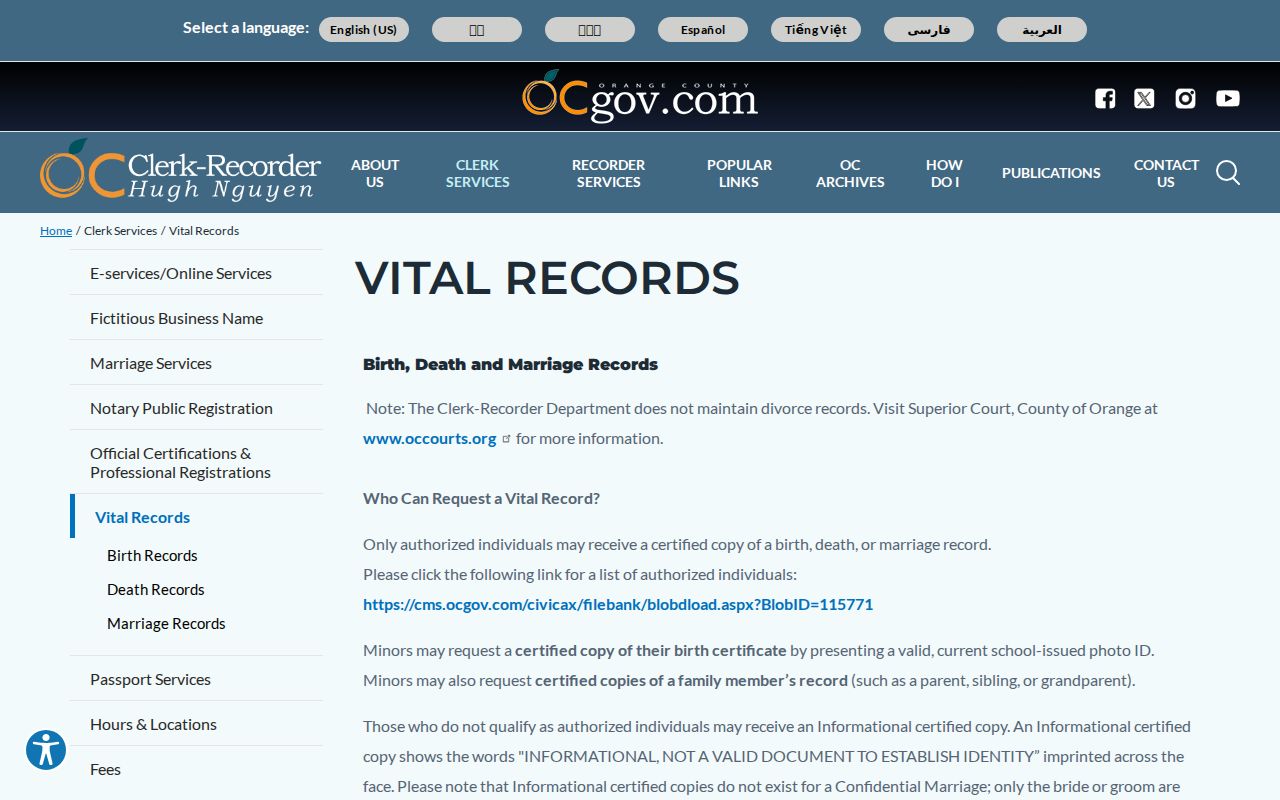
A vital record can prove a family event. Even so, the requester must pick the correct eligibility route and record type before applying.
An Heir Trail Beyond Laguna Niguel
Some of the best resident research is personal and historical. The Controller's unclaimed-property search starts with a name. Add a first name, middle initial, city, or property ID to narrow the results. What comes back may include an owner name and a reported address or city. The results may also show the reporting business, a property type, and a property ID. Those fields can reconnect an heir with an abandoned asset. They do it without proving where anyone lives now.
A likely heir needs stronger paper. Orange County probate access, a recorded transfer, a death record, or a newspaper notice can each firm up the connection. An obituary names relatives and prior communities. But it remains a family-supplied lead rather than a court finding. A probate petition or deed carries real legal weight. The same caution fits a former classmate. Yearbooks, library newspapers, and alumni channels suggest a path. Private contact details should stay unpublished, though.
Professional and business records add a different layer. California's DCA search may show a license number, status, dates, and discipline. SOS bizfile can show an entity number, status, agent, principal address, and filing history. A filing address is often just an office or service address. A name match alone proves little. The entity number and filing date carry more weight than a surface match.
The Department of Consumer Affairs license search is a solid official route. It covers a regulated professional record. It is not a general address list.
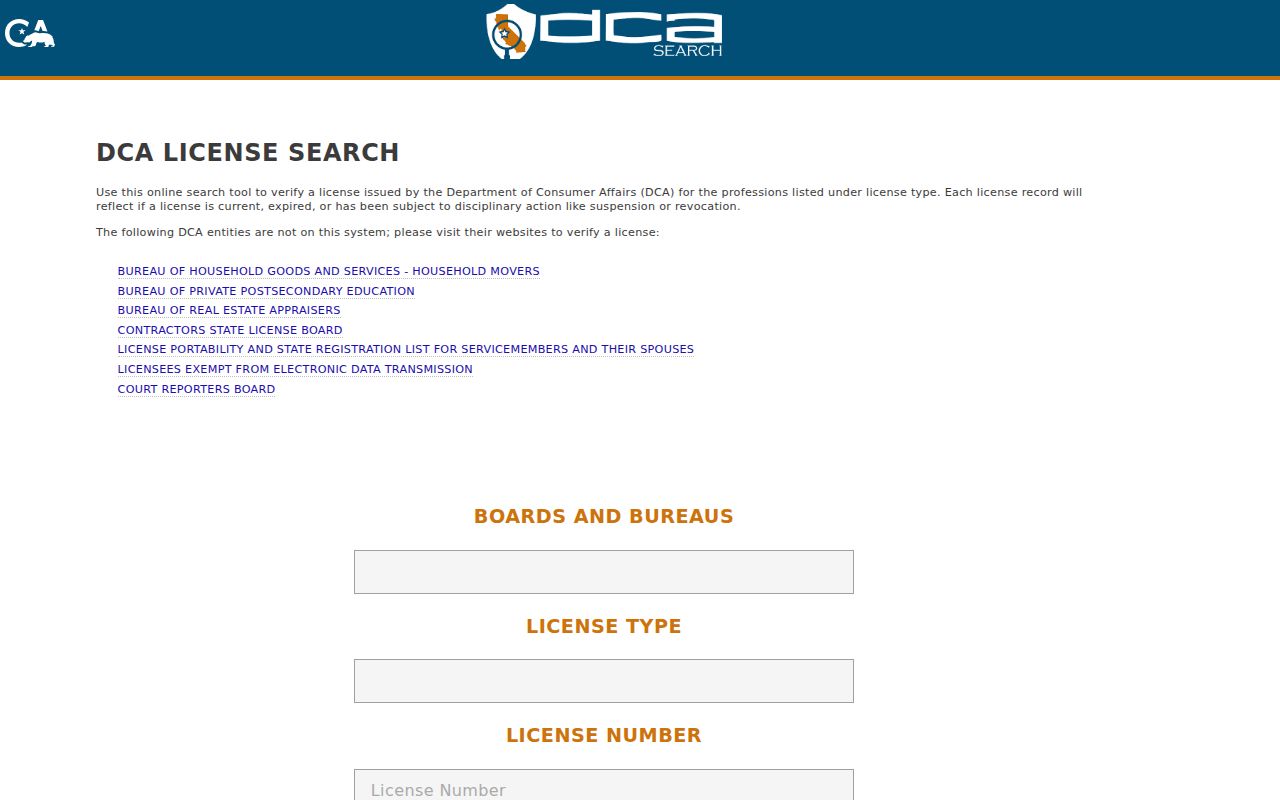
The license screen answers one narrow status question. That narrowness makes it safer to weigh against a separate deed, court, or business result.
Historical Laguna Niguel Directories
Laguna Niguel is a young planned community. Subdivision sales began in 1961. Incorporation followed in 1989, so a long standalone city-directory run should not be assumed. Orange County Archives holds county directories, photographs, newspapers, and property material. Its catalog names no exact publishers, coverage years, or reverse-directory volumes. OCPL adds digitized newspapers, NewsBank access to the Orange County Register from 1987 forward, Ancestry Library Edition, Fold3, HeritageQuest. It also offers the OC Stories oral-history project.
A directory maps a name to an address. A reverse or criss-cross section works the other way, from a street or telephone number. OCPL or Archives staff can confirm those conventions. Use the Laguna Niguel city directory collections page for shelf locations and coverage years. It also lays out a household-tracing method. Modern address evidence belongs with the parcel map and the recorder index.
Printed directories can run thin here. The OCPL digital-newspapers collection then becomes the workhorse for obituaries and announcements. It also yields civic events and address clues.
A historical source can flag a relationship. That is a lead, not proof. A later official record must confirm it before it counts as current.
Safe at Home and Laguna Niguel Records
Some residents are hard to find on purpose. California Safe at Home gives eligible survivors and other protected participants a substitute mailing address, mail forwarding, and a confidential voter-registration route. Government Code §§6205 through 6216 govern the program. Under §6209.5, participants may also request substitute-address treatment for specified deeds, changes of ownership, and deeds of trust, subject to program rules.
The program does not erase history. An earlier deed, court filing, or directory page can still show a protected address in older material. Private organizations are not uniformly required to accept it. The voter record carries its own affidavit and disclosure limits. Enrollment questions belong with an authorized enrolling agency or program staff, not with a general residents directory.
California also allows correction or removal requests at the original custodian when a statute permits. A recorder handles recorded-document issues. A court handles sealed or redacted filings. Election officials handle confidential voter status. The correction target matters more than any downstream copy.
The Safe at Home guidance describes the substitute-address and voting protections.
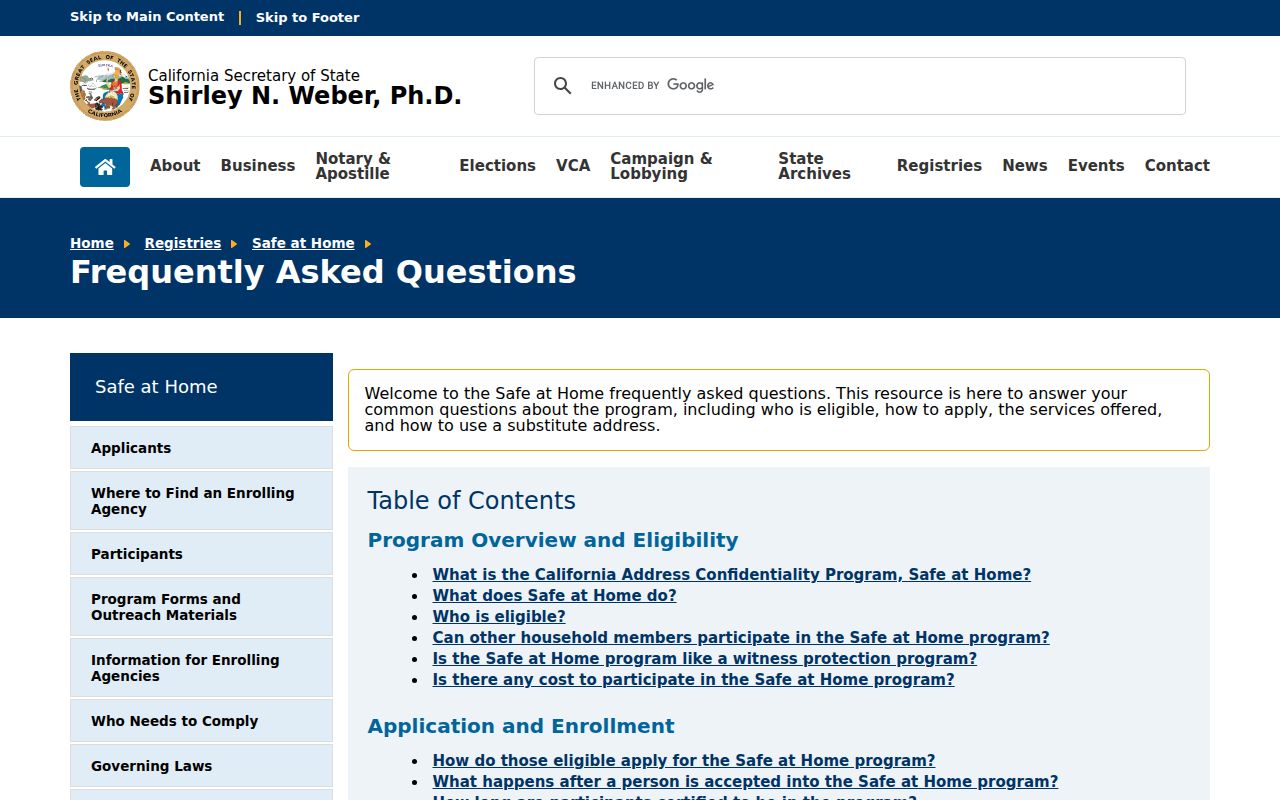
An absent name or address proves nothing. Privacy programs like Safe at Home explain why a person can be part of the community yet missing from ordinary records.
Lawful personal use. Records are for family history, civic research, property curiosity, and other lawful purposes. Do not use a Laguna Niguel resident lead to stalk, harass, intimidate, or harm anyone.
California DROP and Laguna Niguel Privacy
Laguna Niguel residents gained a new state privacy tool. California's free DROP platform launched on January 1, 2026. One verified resident request can reach more than 600 registered data brokers. The state began processing requests on August 1, 2026. Cycles repeat at least every 45 days. Optional matching fields include former names, date of birth, ZIP, email, phone, advertising or connected-device identifiers, and a VIN. A dashboard shows each broker as deleted, exempted, opted-out, not-found, or pending.
DROP never erases the government record itself. A county deed, court file, voter roll, or city permit stays with its custodian no matter what a broker does. Fixing an error means contacting that originating office. Broker deletion is only a downstream step, because public records can remain disclosable even after a commercial copy disappears.
The state's own page is the California DROP privacy portal.
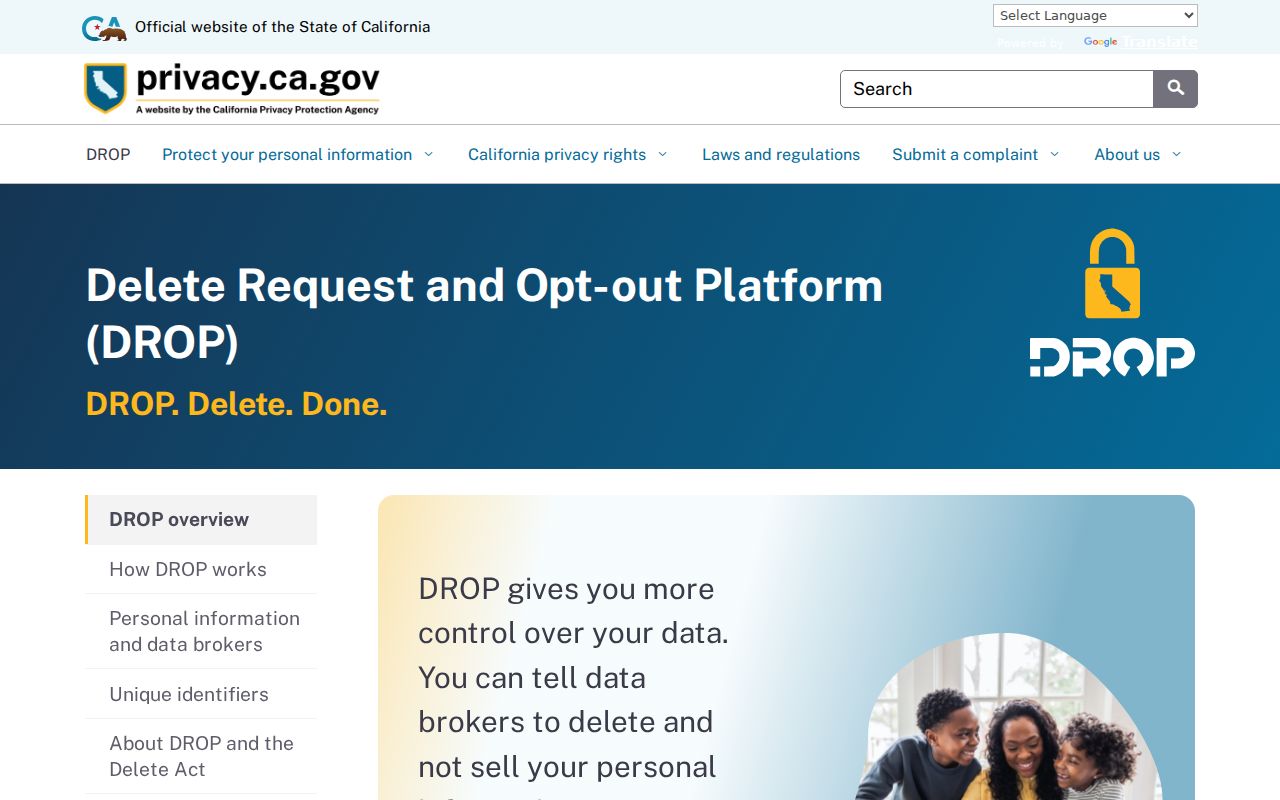
Treat the status categories as a paper trail. They document the privacy request, not a promise that every public source has changed.
When Laguna Niguel Portals End
A dead-end search is usually a routing problem. The Laguna Niguel City Clerk takes focused California Public Records Act requests by email, mail, fax, or in person. The city ordinarily decides within 10 calendar days. A written extension can add up to 14 days. Name the record, plus the date range, an address or parcel, and your preferred format. Leave out any ask that an employee research every person connected to the city.
Other dead ends have specific fixes. Santa Ana microfiche holds recorded instruments. It covers anything dated before January 4, 1982. Older or restricted court material needs a courthouse terminal or a clerk search. The library branch offers in-library digital newspapers and subscription genealogy databases. County-era collections sit in the archives catalog. The South County vital-record counter in Laguna Hills fits some local certificate routes.
Official rolls and people-finder databases answer different questions. An official index gives a custodian, a record type, a date, and a route to correction. A commercial service can mix public fragments with marketing data, infer links, and merge same-name people. The source office remains the place to verify a material fact.
| Source type | Best use | What to save |
|---|---|---|
| Official portal | Search a defined index or self-service record | URL, date, result identifier |
| Counter or microfiche | Older, local, or deeper record access | Book/page, form, clerk guidance |
| Library or archive | Historical household and event clues | Collection title, year, call number |
| Commercial compilation | At most, a lead to verify elsewhere | Never treat an inferred match as proof |
The California Public Records Act makes agencies split disclosable material from exempt material. Staff must also help clarify a focused request. The act never turns every database into an open residents directory. That line protects both sides of a lookup.