
Laguna Niguel Directory Collection Map
The strongest local answer is a coverage table with gaps stated plainly. Research confirmed the existence of Orange County directories in the Archives catalog, but did not verify exact publishers, inclusive year runs, reverse-directory volumes, or a local sample entry. OCPL and the Historical Society provide companion collections. The table shows what each source can contribute without turning an unverified convention into a claimed Laguna Niguel directory entry.
| Collection | Years | Where held | Access |
|---|---|---|---|
| Orange County directories | Exact run not verified | Orange County Archives catalog and staff | Ask for title, publisher, years, and reverse section |
| OCPL Digital Newspapers | Collection-specific issues, including 1920s through 2021 material | Orange County Public Libraries | In-library viewing, printing, and downloading |
| Orange County Register | 1987-current | OCPL NewsBank | Library-card authenticated access |
| Federal census | Through 1950 under the 72-year rule | NARA, branch databases, research libraries | Household snapshot on census date |
| Historical Society archive | Rancho era through cityhood; galleries by decade | Laguna Niguel Historical Society | Inquiry and developing database |
| OC Stories and Acjachemen histories | Modern digital project | OCPL | Community and geography context |
That uncertainty is useful. A researcher can ask the library or Archives for a precise volume instead of searching for a matching Laguna Niguel directory that may never have been printed under that title.
Why Laguna Niguel Lacks a Directory Run
Laguna Niguel is not an old county seat with a century-long municipal directory tradition. Rancho Niguel and county-era records came first. Cabot, Cabot and Forbes formed Laguna Niguel Corporation in 1959 and planned roughly 7,100 acres with Victor Gruen and Associates. Sales began in Monarch Bay and Laguna Terrace in 1961. Avco took over the plan in 1971. A service district followed in 1986, and voters approved incorporation in 1989, effective December 1.
That timeline explains why a city directory search may need regional telephone books, county directories, newspapers, subdivision files, deeds, and HOA or community records. A name printed before cityhood may be filed under Orange County, Rancho Niguel, a tract, or another postal geography. The first question for a directory volume is therefore “what area did it cover?” rather than “what year did the city publish it?”
Modern parcel records can bridge the gap, but the street record and the historical shelf answer different questions. A current APN anchors the land. A directory or newspaper captures a person or household at a date.
Orange County Archives Directory Leads
Orange County Archives describes itself as the principal repository for historic county-government property documents, vital records, photographs, county directories, and newspapers or magazines. Its SydneyPLUS catalog and Archive.org presence can reveal collection descriptions and digitized objects. A catalog hit is not necessarily a scanned page. It may only identify a box, volume, or series that needs a staff question.
Ask four focused questions: the exact title and publisher, the inclusive years, whether an alphabetical and reverse or criss-cross section is present, and whether a researcher may photograph or obtain a scan of a representative Laguna Niguel address entry. Record the call number and coverage area. If the answer is a regional telephone or criss-cross volume, note the postal cities and subdivisions named in its index.
The OCPL history timeline helps place the branch and its local-history access beside the archival directory question.
The county collection view supports a careful catalog-first approach: identify the series before assuming a year run.
OCPL Newspapers Fill Directory Gaps
When a city directory is missing, newspapers often provide the next dated clue. OCPL's Digital Newspapers collection is available inside an OCPL branch and includes the Laguna Niguel edition of Capistrano Valley News along with neighboring coastal newspapers. NewsBank provides a separate card-authenticated route to the Orange County Register from 1987 to the present and the Irvine World News from 2003 to the present. These channels do not have identical coverage or search behavior.
The Laguna Niguel branch is at 30341 Crown Valley Parkway, with 949-249-5252 and ocpl.lagunaniguel@occr.ocgov.com. Hours listed in the research are Sunday 9 to 5, Monday through Thursday 10 to 7, and Friday through Saturday 9 to 5. Ancestry Library Edition requires full-privileges card use inside a branch. Fold3 and HeritageQuest are for full-privileges cardholders, while the digital newspapers remain branch-only.
Search an approximate death date, marriage notice, civic event, organization, or street clue with surname variants. An obituary may name relatives and prior communities, but family-supplied details still need corroboration. A no-result in one interface does not close the newspaper trail.
The OCPL digital-newspapers listing identifies the in-library collection.

The newspaper archive can supply the event date that a missing directory would otherwise have provided.
Inside a Laguna Niguel Directory Entry
No verified Laguna Niguel sample entry was exposed in the research, so the common field pattern must be labeled as a convention rather than a local fact. If Archives or OCPL confirms a regional volume, an alphabetical entry may contain a name, spouse or household reference, occupation, and address. A reverse or criss-cross section may work from an address or telephone. Abbreviations and symbols must be read from that edition's key.
| Possible field | How to handle it |
|---|---|
| Name | Copy the spelling and initials exactly, then test variants |
| Address | Save the printed form before matching it to a modern parcel |
| Household mark | Look for the edition's explanation of spouse, head, or occupant symbols |
| Occupation | Use as a clue, not as proof of present affiliation |
| Reverse section | Confirm that the volume actually includes address or telephone lookup |
- Criss-cross directory
- A reverse directory organized by address or telephone rather than only by surname.
- Householder index
- A name or household list that points to an address or page, depending on the publication.
- Abbreviation key
- The publisher's explanation of marks and shortened occupations, names, or street terms.
- Snapshot
- A dated observation that cannot prove what happened between two editions.
A printed entry becomes more useful when its address is matched to a tract, lot, APN, deed, newspaper notice, or permit date. The modern parcel chain belongs with the Laguna Niguel by-street records, not inside an assumed historical directory run.
Historical Society Photos by Decade
The Laguna Niguel Historical Society formed in 2010 and holds documents, photographs, oral histories, written material, and a developing research database. Its scope runs from Acjachemen life and Spanish or Mexican land grants through ranches, 1959 development, and the 1980s cityhood campaign. Galleries are organized around the 1960s, 1970s, 1980s, and today. Newsletters from 2011 through 2017 are unevenly available.
These materials do not replace a city directory. They can identify when a subdivision phase, landscape, school, civic group, or building entered the local story. Pair a decade photograph with a tract or lot, a deed instrument, or a permit year. Community memory is strongest when the underlying record is also named.
Inquiry is directed to lnhistoricalsociety@gmail.com, 30025 Alicia Parkway #190. The society's holdings are a personal and community-history layer, especially useful when a directory volume is not confirmed.
The official city history supplies the municipal timeline that frames the society's decade galleries.
A decade gallery can place an address in its development era without pretending that a household list survives for every year.
Pair a City Directory With Census Evidence
The federal census is open through 1950 under the 72-year rule. That date creates a local mismatch: the planned community began in 1959 and subdivision sales began in 1961. Most modern Laguna Niguel households therefore will not appear in an open census under the city name. The 1950 census is better for older ranch and county-area families after the correct enumeration geography is reconstructed.
Pair a directory year with the nearest available census only when the place and population fit. A census is a household snapshot on one day. A directory is a publisher's snapshot, and a newspaper may report an event between them. A deed follows title rather than every occupant. Together, those sources can narrow a move or family link without filling an unknown year with an invented fact.
The National Archives census research page explains the federal schedule and public-access rule.
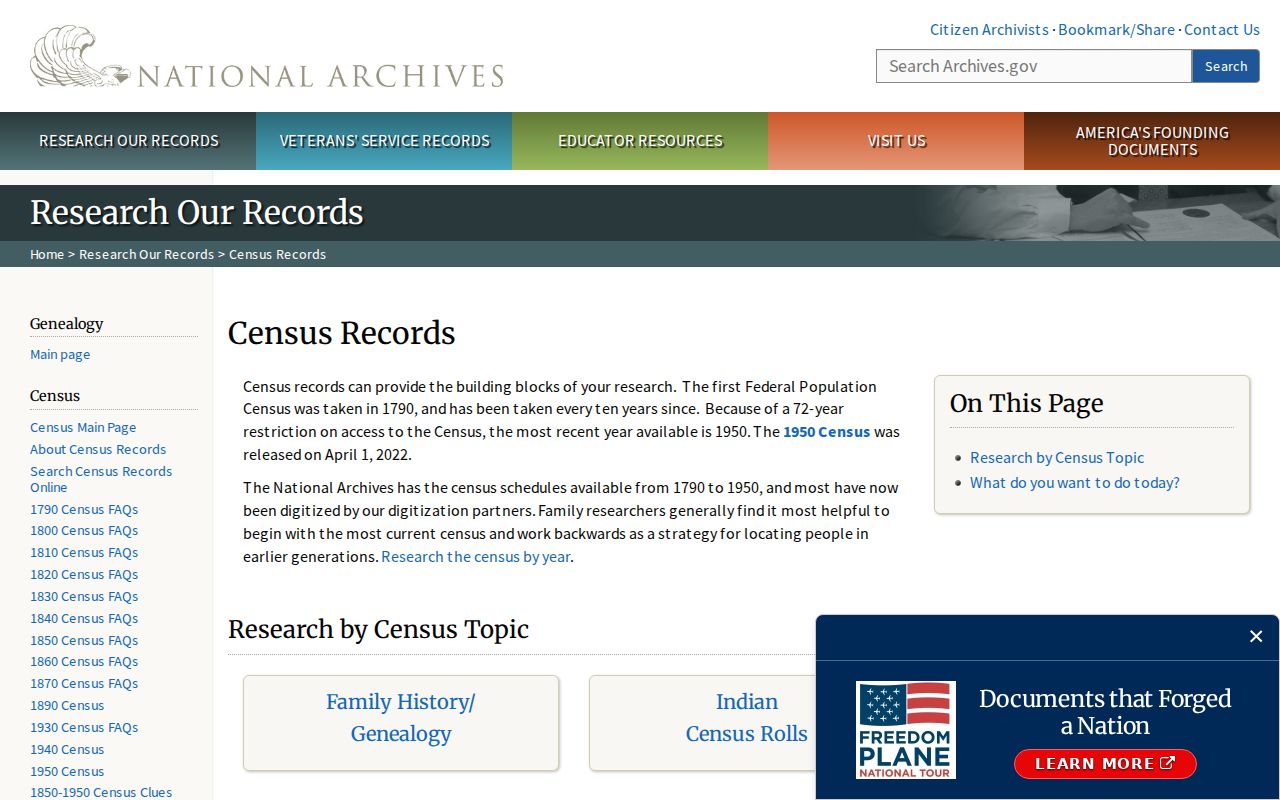
The archive's rule explains why later local directory evidence must carry much of the early subdivision story.
- Record the directory title, publisher, page, address, and exact edition date if known.
- Determine which county, township, postal city, tract, or neighborhood the entry uses.
- Check the nearest open census only after confirming that geography and year align.
- Use a newspaper, deed, permit, or probate record to explain a change between snapshots.
Federal Case Files as a Separate Shelf
A city directory search sometimes finds a name connected to a federal case, but the source is not a local directory. PACER covers the U.S. District Court for the Central District of California and requires an account. It supplies federal party, case, docket, and document access under its own billing and fee rules. County civil, criminal, family, probate, and small-claims cases remain with Orange County Superior Court.
Keep a federal case number and filing date separate from a directory entry. A federal party name is an event or filing relationship, not a residence proof. If the purpose is family history, a docket can point toward dates and names that are then checked against newspapers, probate, or deeds.
The PACER official site is the proper federal route.
The federal shelf is useful only when the record question is federal; it should not be blended into the local directory count.
Laguna Niguel Directory Tracing Workflow
Once a confirmed volume is identified, trace a household in small steps. Start with the earliest plausible surname and address. Copy the printed entry exactly. Follow the name through the next edition, noting a new street, spouse reference, occupation, or disappearance. Then turn to the reverse section, if the volume has one, to see whether an address points to the same household or to another occupant.
- Ask OCPL or Archives to verify the title, publisher, years, coverage area, and reverse section.
- Find the first appearance and save the edition, page, spelling, address, and any abbreviation key.
- Compare the next available edition, then explain a move with a deed, newspaper, permit, or family record.
- Pair a dated directory snapshot with the 1950 census only when the historical geography matches.
- Close a death or estate trail with an obituary, probate file, vital copy, or recorded transfer.
A name disappearing from one directory can mean a move, death, an unlisted entry, a publication gap, or a change in coverage. No single explanation should be chosen without a second source. If the lookup ends in modern ownership rather than historical occupants, move to the parcel and deed chain.
Laguna Niguel Directory Timeline
The local timeline is more certain than the exact city directory run. It explains why the historical shelf must be searched by county and development era.
| Date | Records context |
|---|---|
| 1842 | Juan Avila received Rancho Niguel; later title research reaches land-grant and county-era material. |
| 1889 | Orange County was created, placing later county records with county custodians. |
| 1959 | Laguna Niguel Corporation and the planned-community design began. |
| 1961 | Monarch Bay and Laguna Terrace sales began. |
| 1989 | Voters approved incorporation, effective December 1. |
| 1987-current | OCPL NewsBank coverage for the Orange County Register provides a late-century event trail. |
The timeline is not a substitute for a verified directory publisher or year. It is the reason a directory request should name the record's geography and not assume that “city directory” means a local municipal publication.
The Orange County Clerk-Recorder services page supplies the county office context paired with this collection note.
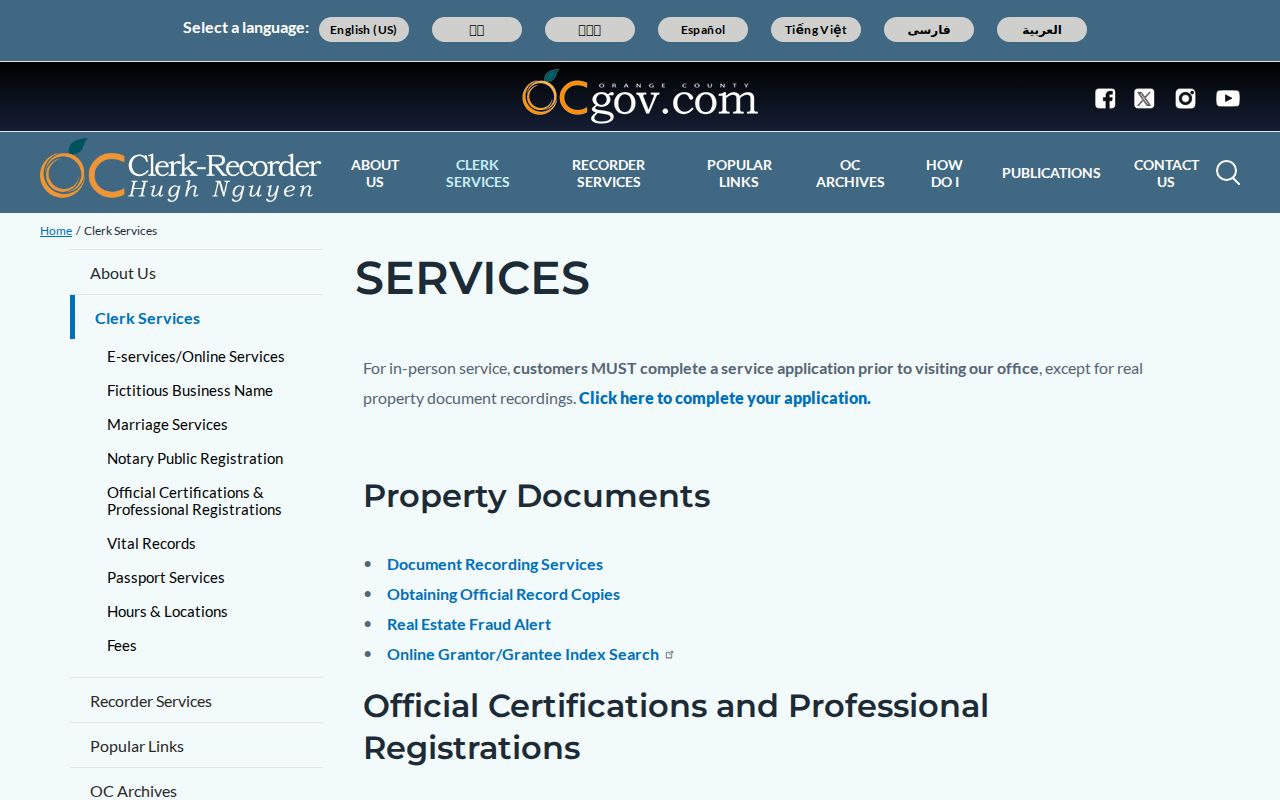
County service context helps separate present-day records access from the historical collection inquiry.