
How Laguna Niguel Residents Are Found
Begin with the fact you need, not with the broadest possible name search. An ownership question points toward the Laguna Niguel Public GIS Viewer, the Orange County Assessor, and the Clerk-Recorder's Grantor-Grantee Index. A court event belongs in the Orange County Superior Court search. A birth, death, or marriage question belongs with the county clerk or California Department of Public Health. Older family research moves through newspapers, census schedules, directories, and archives. The most reliable Laguna Niguel residents directory work is a chain of small checks.
Those sources do not describe the same population. A deed names parties to an instrument. A parcel map locates land. A court index records a case event. A voter status page lets a person confirm their own registration. None of those results proves that every person connected to a parcel lives there now. Keep names, dates, roles, and identifiers in separate notes so a useful lead does not become an unsupported conclusion.
- Write down the goal, such as a parcel owner, a past household, an heir, or a public affiliation.
- Fix the geography with a street address, APN, tract, lot, or ZIP before comparing names.
- Use the custodian with the closest record type, then save the date, case number, instrument number, or license number.
- Confirm the lead with an independent source, such as a deed against an APN or a court case against a filing date.
- Use a focused city or county request when the online index ends, rather than asking staff to build a people list.
For street-by-street work, the city map is the useful first bridge. For one person, the identity checks matter more than a long list of hits.
Where Laguna Niguel Keeps Resident Records
Laguna Niguel became a city in 1989, so its records are split by era and custodian. City Hall holds municipal minutes, permits, planning material, contracts, and code or administrative records. Orange County holds the durable property, vital, court, election, and recorded-document trail. California agencies control statewide programs such as voter status, professional licenses, business entities, and confidentiality services. The office cards below identify the practical starting points.
Orange County Clerk-Recorder
601 N. Ross Street
Santa Ana, CA 92701
714-834-2500
Orange County Assessor
500 S. Main Street
Orange, CA 92868
714-834-2727
Orange County Registrar
1300 S. Grand Avenue, Building C
Santa Ana, CA 92705
Approved-file route
The Laguna Niguel City Clerk is another important custodian for local records. Requests can go to cityclerk@cityoflagunaniguel.org, City Hall at 30111 Crown Valley Parkway, by fax at 949-362-4340, or by mail. The clerk's line is 949-362-4301, and City Hall hours are Monday through Friday, 8 a.m. to 5 p.m. Copies are listed at $0.10 per page. A city request can be useful for a permit, contract, meeting record, or planning file, but it is not a substitute for an Orange County deed or court search.
Laguna Niguel Records Across Three Levels
The city, county, and state layers answer different parts of a resident question. City records show how a planned community was administered, when a permit or council action occurred, and which local program handled an address. County systems connect parcels to recorded parties, cases, certificates, and election administration. State portals add entity, license, custody, privacy, and archival routes. Confusing those levels is a common reason a search appears empty.
| Level | Useful source | Evidence | Boundary |
|---|---|---|---|
| City | City Clerk, Permit Center, Public GIS Viewer | Municipal action, parcel context, permits | Pre-1989 plans may not be held by the city |
| County | Clerk-Recorder, Assessor, Superior Court | Deeds, values, cases, vital copies | Each office has its own access rules |
| State | Secretary of State, CDPH, DCA, Safe at Home | Entities, certificates, licenses, protections | Many results are not residence proof |
| Federal | NARA census, PACER, federal custody tools | Historical households or federal cases | Coverage follows federal rules and dates |
The historical boundary is especially important here. Rancho Niguel and county-era records predate the modern city label. Searching only for Laguna Niguel can miss an earlier entry filed under Orange County, a tract, a lot, or a predecessor geography.
How the Laguna Niguel Deed Index Works
The Orange County Grantor-Grantee Index is free to search, but it is an index rather than a free image library. Online coverage begins January 4, 1982. Earlier documents remain on microfiche at the Santa Ana office. A pre-1982 reference normally uses book, page, and instrument information. A 1982-forward instrument uses the recording year plus a six-digit number. Find the identifier first, then order a copy or inspect the record through the custodian.
| Search control | What to enter |
|---|---|
| Name role | All, Grantor, Grantee, or both roles |
| Name | LAST FIRST; partial names are accepted, and a partial first name can reduce timeouts |
| Date range | Recording date from and to in MM/DD/YYYY format |
| Document number | Annual recording number when known |
| Book and page | Useful for pre-1982 instruments and recorded maps |
| APN or legal description | Parcel or lot/tract search that helps separate same-name parties |
Results can display 10, 20, 50, or 100 items. The detail view may show party, role, document type, date, document number, book and page, APN, or legal description. A name link can expose connected documents from 1982 forward. Copies are listed at $1 per page plus $1 certification per document or map, and mail orders require a self-addressed stamped envelope and check. The office does not perform the researcher's name search by phone, mail, or counter.
- Grantor
- The party transferring an interest or signing the recorded instrument.
- Grantee
- The party receiving an interest or named as the recipient in the instrument.
- Index
- A catalog entry that points to a record; it is not the same as the document image.
- Parcel
- A defined piece of land identified by an APN and related legal description.
The Laguna Niguel APN Screen
The county assessed-value screen has a narrower purpose than many searchers expect. It accepts an APN in a masked 999-999-99 format and returns land, buildings and improvements, other improvements, personal property, total assessed value, exemption, net value, and the data-current date. It does not show an owner name, owner mailing address, situs address, occupant, deed image, or complete sale history on the inspected result.
That limitation makes the city map a useful companion. The Laguna Niguel Public GIS Viewer accepts an address or APN and exposes the parcel number, zoning, General Plan designation, HOA, tract, lot, coordinates, and electric provider. The GIS answer is geography and planning context. The Assessor answer is assessed value. The recorder answer is an indexed transaction trail.
A county property-information page routes readers toward ParcelQuest and the Public Service Counter. Roll products may require a counter or focused written request, and the research lists fees for parcel maps, index maps, roll pages, copies, and certification. Do not present the free APN value result as a by-name Laguna Niguel residents directory.
Source context is visible in the Orange County Assessor property gateway. The captured official property page is useful because it shows the route into the county system, while the value query shows exactly which fields are public in that screen.
The county gateway view illustrates the distinction between a county search route and a residents list.
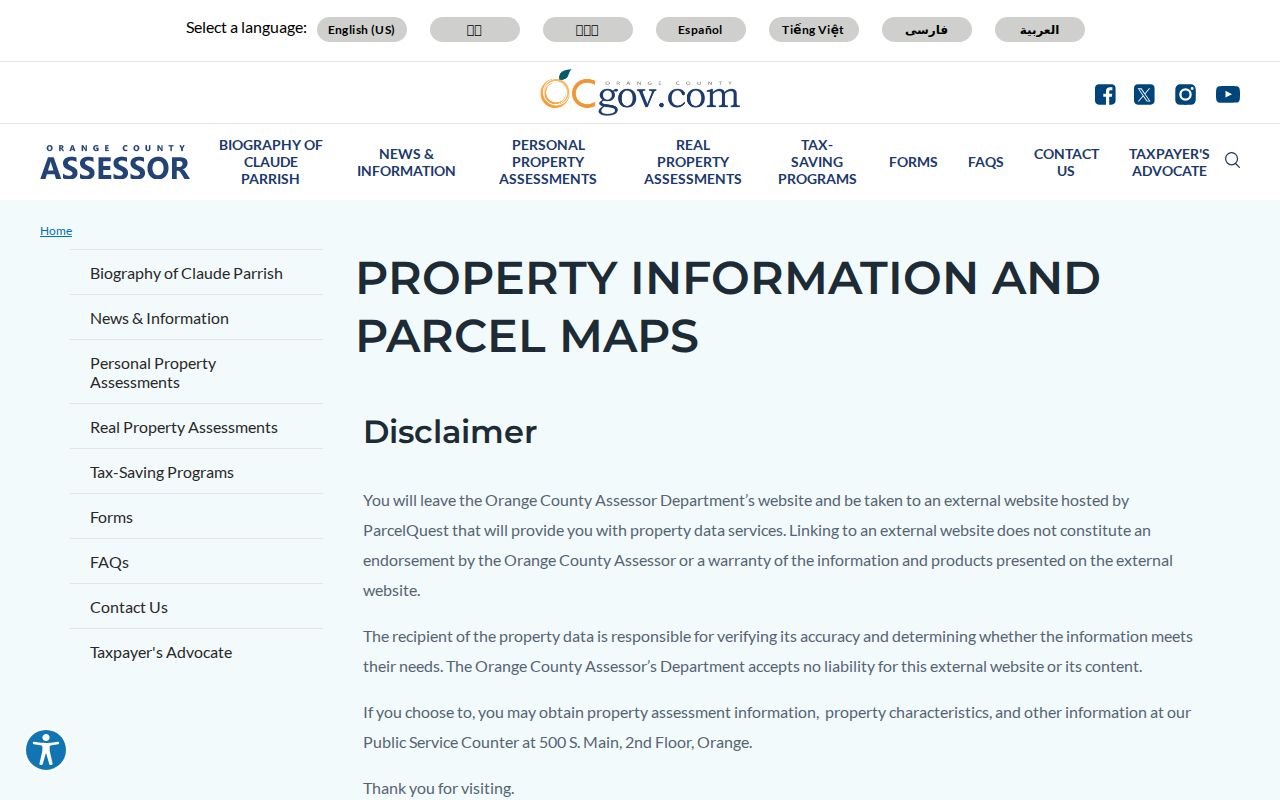
The screen is strongest when paired with the APN from the city map and the instrument number from the recorder index.
Current Laguna Niguel Resident Sources
Current records are better understood as a set of partial directories. The city staff directory lists public employees, not the general population. The recorder index lists parties to recorded instruments. A voter file can contain residence fields only through an approved statutory route, while My Voter Status is a self-lookup. Business and license portals show an affiliation or regulated status. Use the source that fits the question.
| Source | What it can show | Keeper | Access |
|---|---|---|---|
| Public GIS Viewer | Parcel, tract, lot, HOA, zoning | City of Laguna Niguel | Free address/APN map |
| Assessed-value query | APN values and exemptions | Orange County Assessor | Free APN query |
| Grantor-Grantee Index | Deed and lien parties | Clerk-Recorder | Free index, paid copies |
| My Voter Status | One voter's registration details | California Secretary of State | Identity-gated self-lookup |
| Business and license portals | Entity, license, status, filed address | California agencies | Free public searches vary |
That table also explains why a single result should not be called a complete Laguna Niguel residents directory. It is more accurate to say that the records form a resident trail, with each step tied to a custodian and a date.
Orange County Court Matches Need Anchors
The Orange County Superior Court Case Access hub separates civil, criminal and traffic, family, probate, and small-claims routes. The Case Name Search requires an account and purchased credits for ordinary searches. Exact and Similar matching are available, but alias searching is not. A result normally supplies a party or business name, case number, and filing date, with a register of actions or category-specific detail when remote access permits.
Use the case number and filing date as the second identifier. A calendar result is not a certified record, and a party match does not establish a current address or the outcome of a dispute. Civil, family, probate, and criminal records differ in coverage and document access. Family summaries generally reach cases opened in 1990 or later, while courthouse terminals and clerk procedures may expose additional public material.
The Orange County case-access hub shows the category split. Federal cases belong in PACER rather than the county search. Older or restricted records may require a clerk request, counter terminal, identification, or a court order.
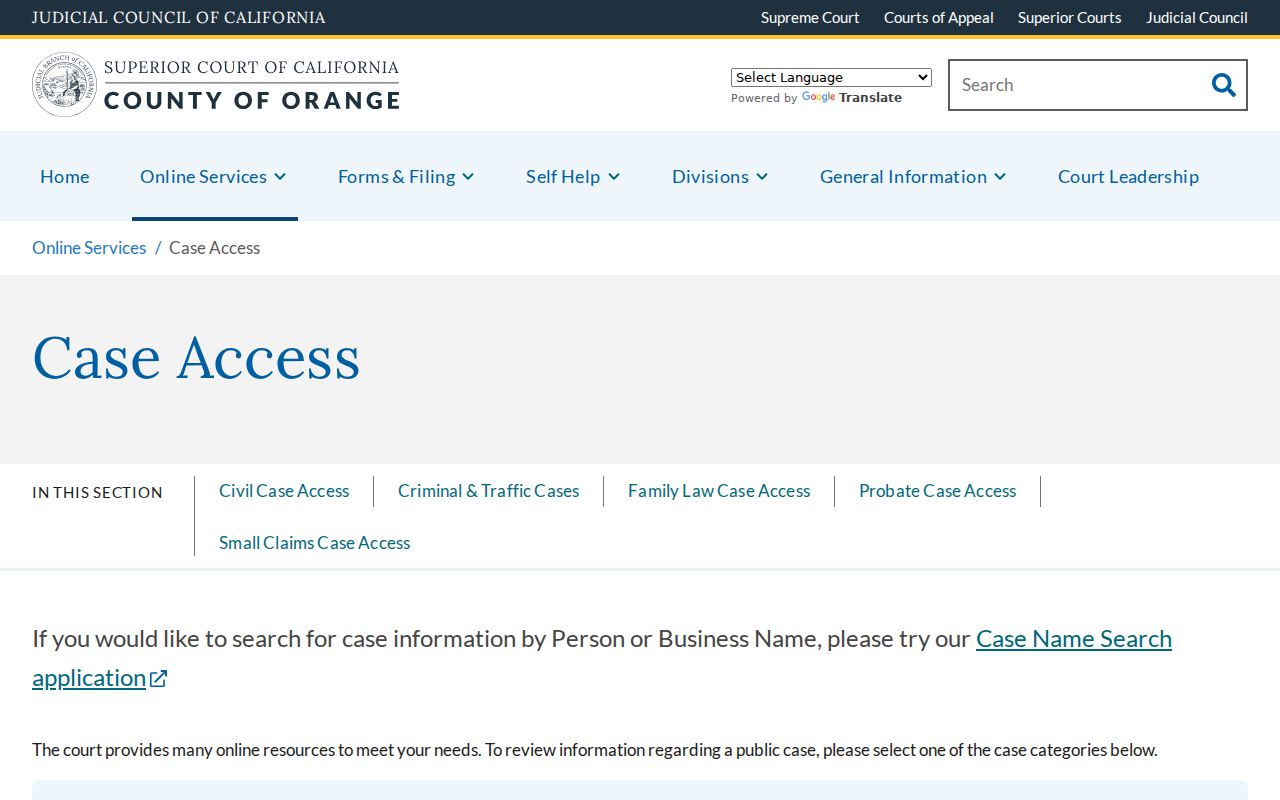
The court access view is a map of routes, not a promise that every case file is online.
California Voter Records Have a Gate
California voter information is not an open name-and-street directory. The California Secretary of State My Voter Status service asks for a date of birth, the last four digits of a California license or identification number or an alternative identifier, and the first three characters of the first name. It is designed for a voter to confirm their own registration. The Orange County Registrar can release a controlled file only for an approved election, scholarly, journalistic, political, or governmental purpose.
| Authorized field | Meaning or restriction |
|---|---|
| Residence and mailing address | May differ; protected voters are omitted |
| Registration and precinct | Election geography and status |
| Party preference | Registration preference, not a ballot choice |
| Participation history | Election and voting method history, never selections |
| License, SSN, signature | Confidential identifiers, not routine released fields |
Election Code §2194 bars personal, commercial, advertising, solicitation, marketing, and harassment uses. The Orange County application requires a purpose, wet signature, supporting documents, payment, and a government photo ID copy for a mail request. Protected voters under Elections Code §§2166 through 2166.9 are excluded. That is why a self-lookup and an approved data request must never be described as the same service.
The California voter-status lookup is the correct ordinary starting point for a person checking their own record.
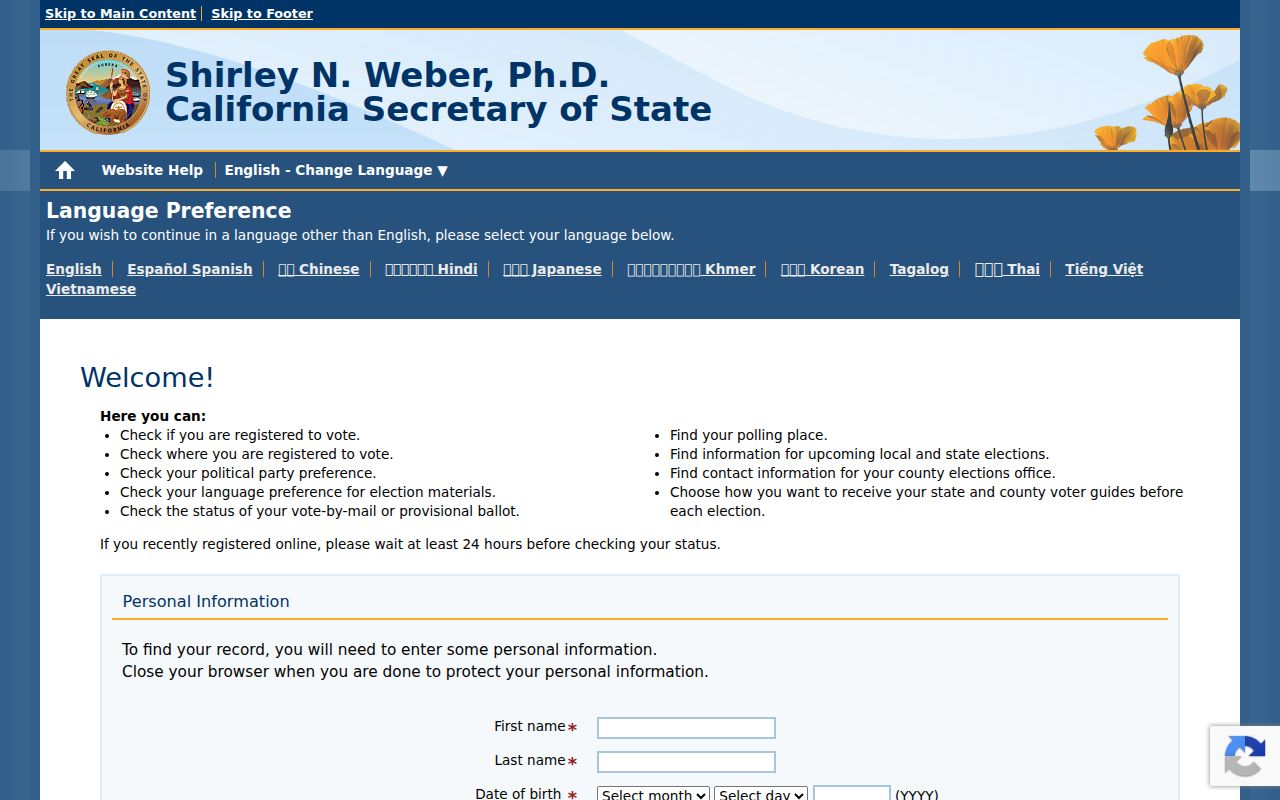
Its identity gate is the key fact: the form does not turn Laguna Niguel streets into a public voter roll.
Laguna Niguel Vital Copy Choices
Birth, death, and marriage records are event records, not a current residents directory. The Orange County Clerk-Recorder handles county copies, while CDPH Vital Records maintains statewide files and amendments. Divorce decrees come from the Orange County Superior Court. A dissolution certificate from CDPH is a different product from the court file.
| Record | Custodian | Copy route | 2026 fee in research |
|---|---|---|---|
| Birth | County or CDPH | Authorized or informational certified copy | Orange County $34; CDPH $31 |
| Death | County or CDPH | Eligibility varies by requester and relation | $26 |
| Public marriage | County or CDPH | Authorized or informational copy | $19 |
| Confidential marriage | Issuing county clerk | Spouses or court-authorized requester | $19 county schedule where applicable |
| Dissolution certificate | CDPH | State application; decree remains with court | $18 |
Health and Safety Code §103526 distinguishes authorized identity-valid copies from informational copies marked not valid to establish identity. Authorized mail requests need a sworn, notarized statement. California has no simple rule that makes every modern copy open after a fixed number of years. The county offers counters in Santa Ana, Anaheim, and South County in Laguna Hills, while county mail requests go to Santa Ana and state requests follow form-specific instructions.
The Orange County vital-records service page explains the local counter and mail routes.
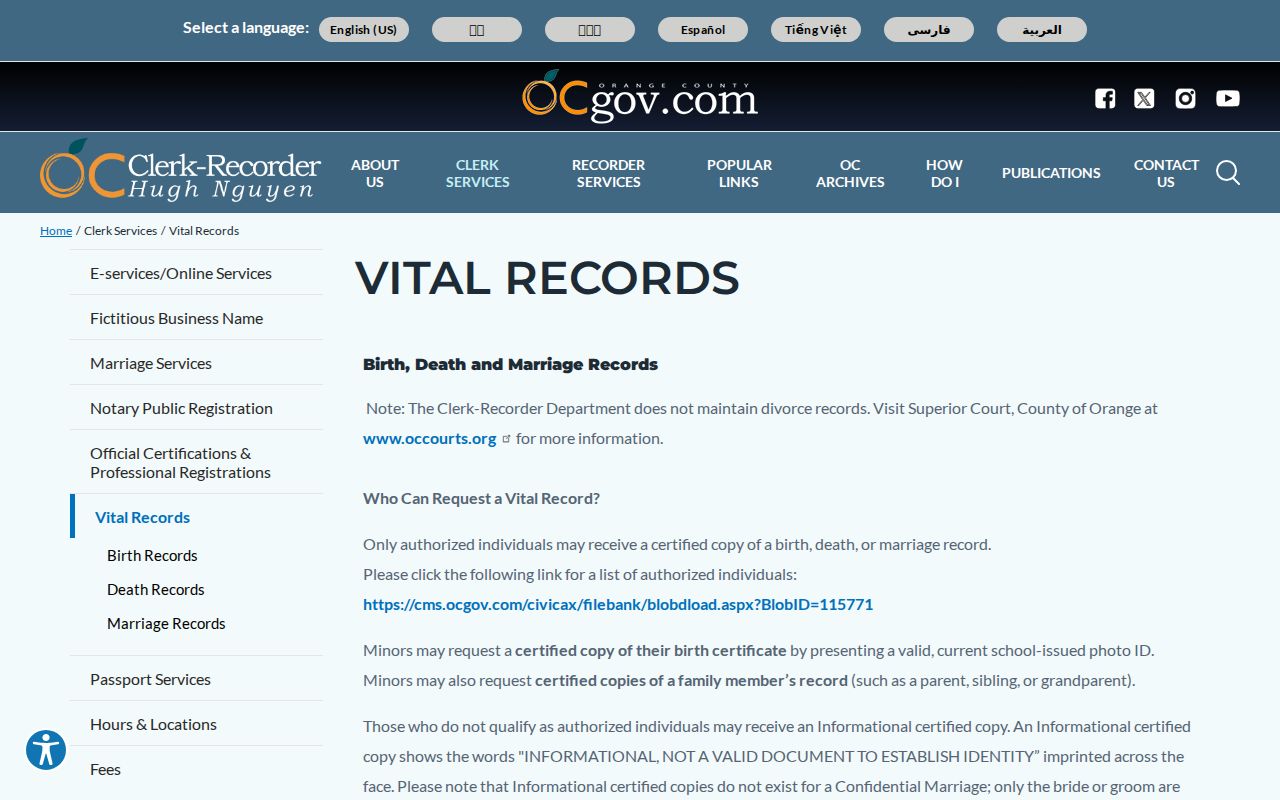
A vital record can confirm a family event, but the requester still needs the right eligibility route and record type.
An Heir Trail Beyond Laguna Niguel
Some of the most useful resident research is personal and historical. The State Controller's unclaimed-property search accepts a last or business name and can add a first name, middle initial, city, or property ID. Results may show an owner name, reported address or city, reporting business, property type, and property ID. Those fields can reconnect an heir with an abandoned asset without proving a current residence.
For a likely heir, pair that lead with Orange County probate access, a recorded transfer, a death record, and a newspaper notice. An obituary can identify relatives and prior communities, but it remains a family-supplied lead rather than a court finding. A probate petition or deed supplies a stronger legal connection. The same rule applies to a former classmate: yearbooks, library newspapers, and alumni channels can suggest a path, while private contact details should not be published.
Professional and business records add a different affiliation layer. California's DCA search may show a license number, status, dates, and discipline. SOS bizfile can show an entity number, status, agent, principal address, and filing history. A filing address can be an office or service address, so the entity number and filing date matter more than a name match alone.
The Department of Consumer Affairs license search is a useful official route for a regulated professional record. It is not a general address list.
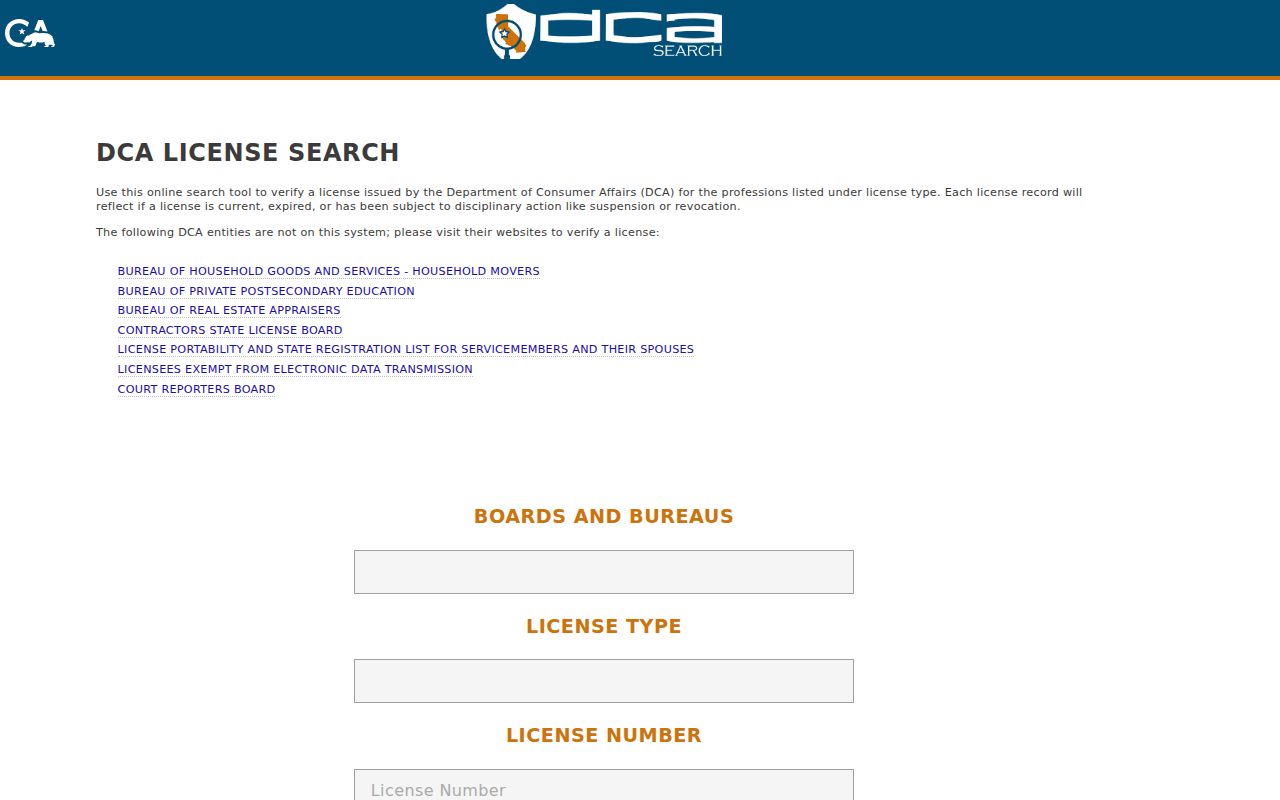
The license screen answers a narrow status question, which makes it safer to compare with a separate deed, court, or business result.
Historical Laguna Niguel Directories
Laguna Niguel is a young planned community. Subdivision sales began in 1961 and incorporation followed in 1989, so a long standalone city-directory run should not be assumed. Orange County Archives confirms county directories, photographs, newspapers, and property material, but its inspected catalog did not verify exact publishers, inclusive years, reverse-directory volumes, or a representative local entry. OCPL adds digitized newspapers, NewsBank access to the Orange County Register from 1987 forward, Ancestry Library Edition, Fold3, HeritageQuest, and the OC Stories oral-history project.
A directory, when a regional volume covers the address, can provide a name-to-address snapshot. A reverse or criss-cross section may work from a street or telephone. Those conventions need confirmation from OCPL or Archives staff before being presented as a verified Laguna Niguel collection. For the shelf, years, and a household-tracing method, use the Laguna Niguel city directory collections page. Modern address evidence belongs with the parcel map and recorder index.
The OCPL digital-newspapers collection is particularly useful for obituaries, announcements, civic events, and address clues when a printed directory is absent.
Historical sources can identify a relationship or event, but a later official record is needed before treating the lead as current.
Safe at Home and Laguna Niguel Records
Some residents are intentionally difficult to find in ordinary records. California Safe at Home provides eligible survivors and other protected participants with a substitute mailing address, mail forwarding, and a confidential voter-registration route. Government Code §§6205 through 6216 govern the program. Participants may also request substitute-address treatment for specified deeds, changes of ownership, and deeds of trust under §6209.5, subject to program rules.
The program does not erase an earlier deed, court filing, or directory page. A protected address may still appear in older material, and private organizations are not uniformly required to accept the substitute address. The voter record has its own affidavit and disclosure limits. Questions about enrollment belong with an authorized enrolling agency or program staff, not with a general residents directory.
California also permits correction or removal requests at the original custodian when a statute allows it. A recorder handles a recorded-document issue, a court handles a sealed or redacted filing, and election officials handle confidential voter status. The correction target matters more than a downstream copy.
The Safe at Home guidance describes the substitute-address and voting protections.
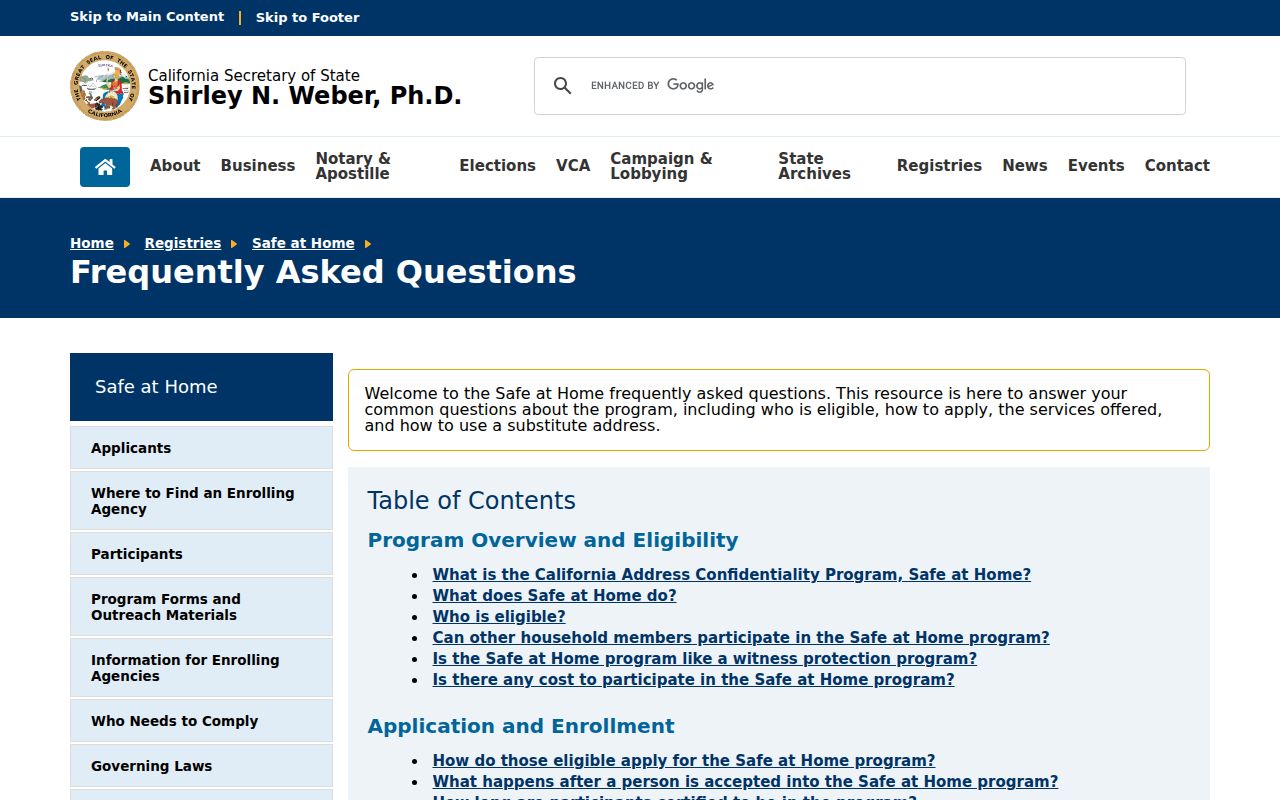
Privacy programs explain why an absent name or address is not proof that a person is absent from the community.
Lawful personal use. Records are for family history, civic research, property curiosity, and other lawful purposes. Do not use a Laguna Niguel resident lead to stalk, harass, intimidate, or harm anyone.
California DROP and Laguna Niguel Privacy
California's privacy system separates official records from copies held by data brokers. The free DROP platform launched January 1, 2026. The state says one verified resident request can reach more than 600 active registered brokers. Processing began August 1, 2026 and repeats at least every 45 days. Optional matching fields include former names, date of birth, ZIP, email, phone, advertising or connected-device identifiers, and VIN. The dashboard can show deleted, exempted, opted-out, not-found, or pending statuses.
DROP does not erase a county deed, court file, voter record, or city permit. A resident who needs an originating record corrected must contact that custodian. A broker deletion is a separate downstream step. Government public records may remain subject to disclosure even when a commercial copy is removed.
The state source for the current service is the California DROP privacy portal.
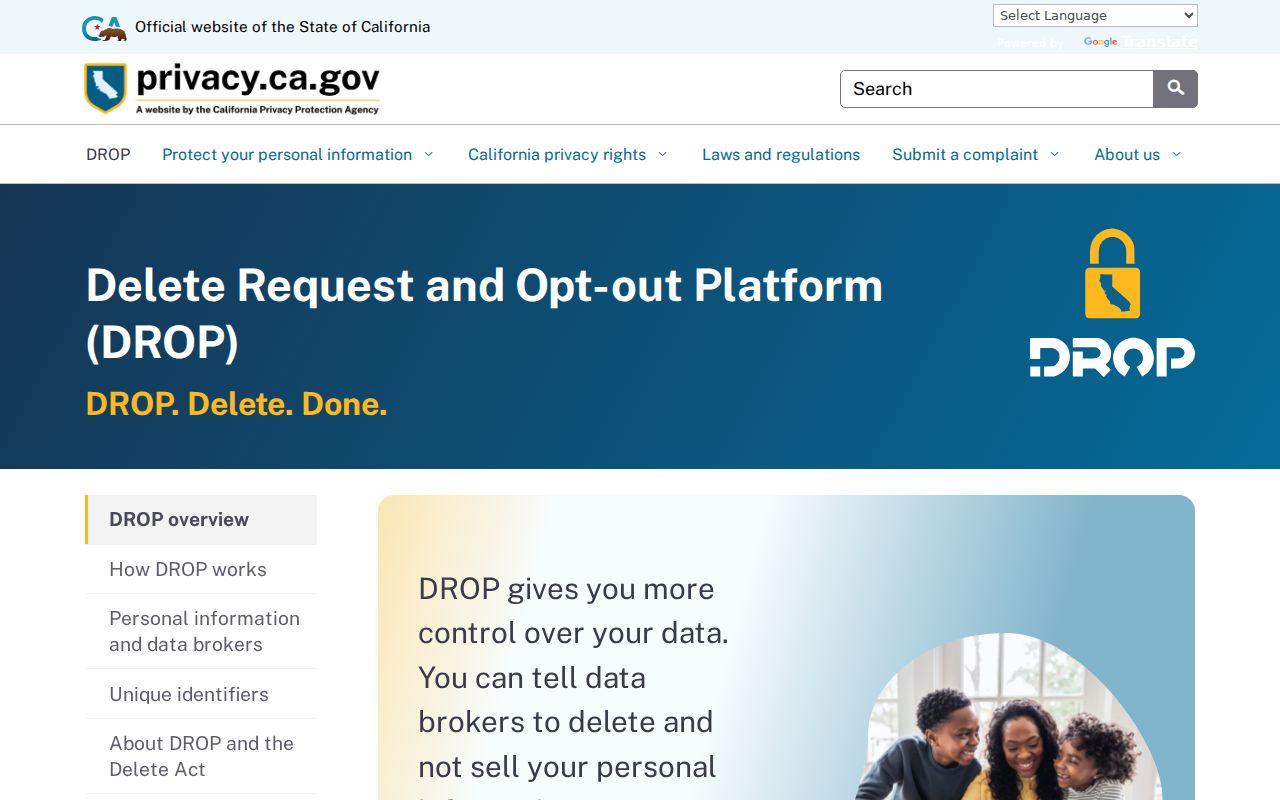
Use the status categories as a record of the privacy request, not as a promise that every public source has changed.
When Laguna Niguel Portals End
A missing search result is often a routing problem. The City Clerk accepts a focused California Public Records Act request by email, mail, fax, or in person. The city ordinarily makes a determination within 10 calendar days, with a written extension of up to 14 days in unusual circumstances. A request should identify the record, date range, address or parcel, and preferred format. It should not ask an employee to research every person connected to a city.
Other fallbacks are specific. Use Santa Ana microfiche for recorded instruments before January 4, 1982. Use a courthouse terminal or clerk search for older or restricted court material. Use the library branch for in-library digital newspapers and subscription genealogy databases. Use the archives catalog for county-era collections. Use the South County vital-record counter in Laguna Hills when a local certificate route fits.
Official rolls and commercial people-finder databases also answer different questions. An official index gives a custodian, a record type, a date, and a route to correction. A commercial service may combine public fragments, marketing data, and inferred links, and may merge same-name people. The source office remains the place to verify a material fact.
| Source type | Best use | What to save |
|---|---|---|
| Official portal | Search a defined index or self-service record | URL, date, result identifier |
| Counter or microfiche | Older, local, or deeper record access | Book/page, form, clerk guidance |
| Library or archive | Historical household and event clues | Collection title, year, call number |
| Commercial compilation | At most, a lead to verify elsewhere | Never treat an inferred match as proof |
The California Public Records Act requires agencies to separate disclosable portions from exempt material and help clarify a focused request. It does not turn every database into an open residents directory. That distinction protects both the researcher and the person named in the record.